

Blurb
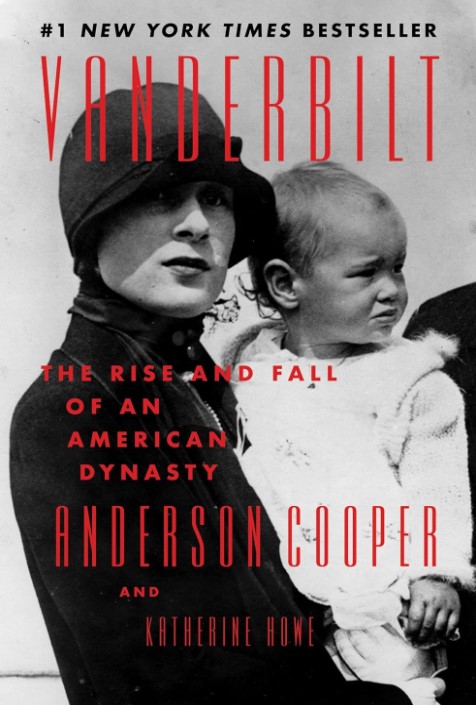
New York Times bestselling author and journalist Anderson Cooper teams with New York Times bestselling historian and novelist Katherine Howe to chronicle the rise and fall of a legendary American dynasty—his mother’s family, the Vanderbilts.
One of the Washington Post‘s Notable Works of Nonfiction of 2021
When eleven-year-old Cornelius Vanderbilt began to work on his father’s small boat ferrying supplies in New York Harbor at the beginning of the nineteenth century, no one could have imagined that one day he would, through ruthlessness, cunning, and a pathological desire for money, build two empires—one in shipping and another in railroads—that would make him the richest man in America. His staggering fortune was fought over by his heirs after his death in 1877, sowing familial discord that would never fully heal. Though his son Billy doubled the money left by “the Commodore,” subsequent generations competed to find new and ever more extraordinary ways of spending it. By 2018, when the last Vanderbilt was forced out of The Breakers—the seventy-room summer estate in Newport, Rhode Island, that Cornelius’s grandson and namesake had built—the family would have been unrecognizable to the tycoon who started it all.
Now, the Commodore’s great-great-great-grandson Anderson Cooper, joins with historian Katherine Howe to explore the story of his legendary family and their outsized influence. Cooper and Howe breathe life into the ancestors who built the family’s empire, basked in the Commodore’s wealth, hosted lavish galas, and became synonymous with unfettered American capitalism and high society. Moving from the hardscrabble wharves of old Manhattan to the lavish drawing rooms of Gilded Age Fifth Avenue, from the ornate summer palaces of Newport to the courts of Europe, and all the way to modern-day New York, Cooper and Howe wryly recount the triumphs and tragedies of an American dynasty unlike any other.
Written with a unique insider’s viewpoint, this is a rollicking, quintessentially American history as remarkable as the family it so vividly captures.
Review
This is another one of the books I ready thanks to having a shared library with my wife. She previously read this and enjoyed it, and I’m a fan generally speaking of historical biographies, so I gave it is shot.
Sky view of the book: I just don’t have enough of a fascination with the rich and royal to have gotten into this one. I think I would have preferred a book entirely on the Commodore, not the rest that followed. Because this version of the story doesn’t really get into how Cornelius Vanderbilt built the family fortune, basically only mentioning that he did it in the shipping and railroad businesses. I would have been interested in the details of that. Instead, we get extravagant detail on the extravance in whole–the balls, the houses, the mansions, the high society. And I’m sure that stuff is of interest to plenty. Just, not me. Not sure if that is because I grew up poor or not. I can’t relate to much of this, but I also would like to think I wouldn’t care to even if I could.
For me, the most interesting parts of the book were about Harold Stirling Vanderbilt and his yacht racing in the America’s Cup, because that was the closest this book got to exploring anything related to merit or skill. That may just be the old sportswriter in me, however. That meant more to me than the family drama or who was pissed at Truman Capote for whatever reason.
 I Am Weez