

Blurb
A pragmatic philosophy more popular than ever – here are 52 ancient lessons to help you overcome adversity and find tranquility in the modern world.
An ancient belief system made new, Stoicism teaches us how to accept the things we cannot change and how to live a good life. It helps us improve our outlook, increase our well-being, and thrive in the face of adversity. But how does one live like a Stoic?
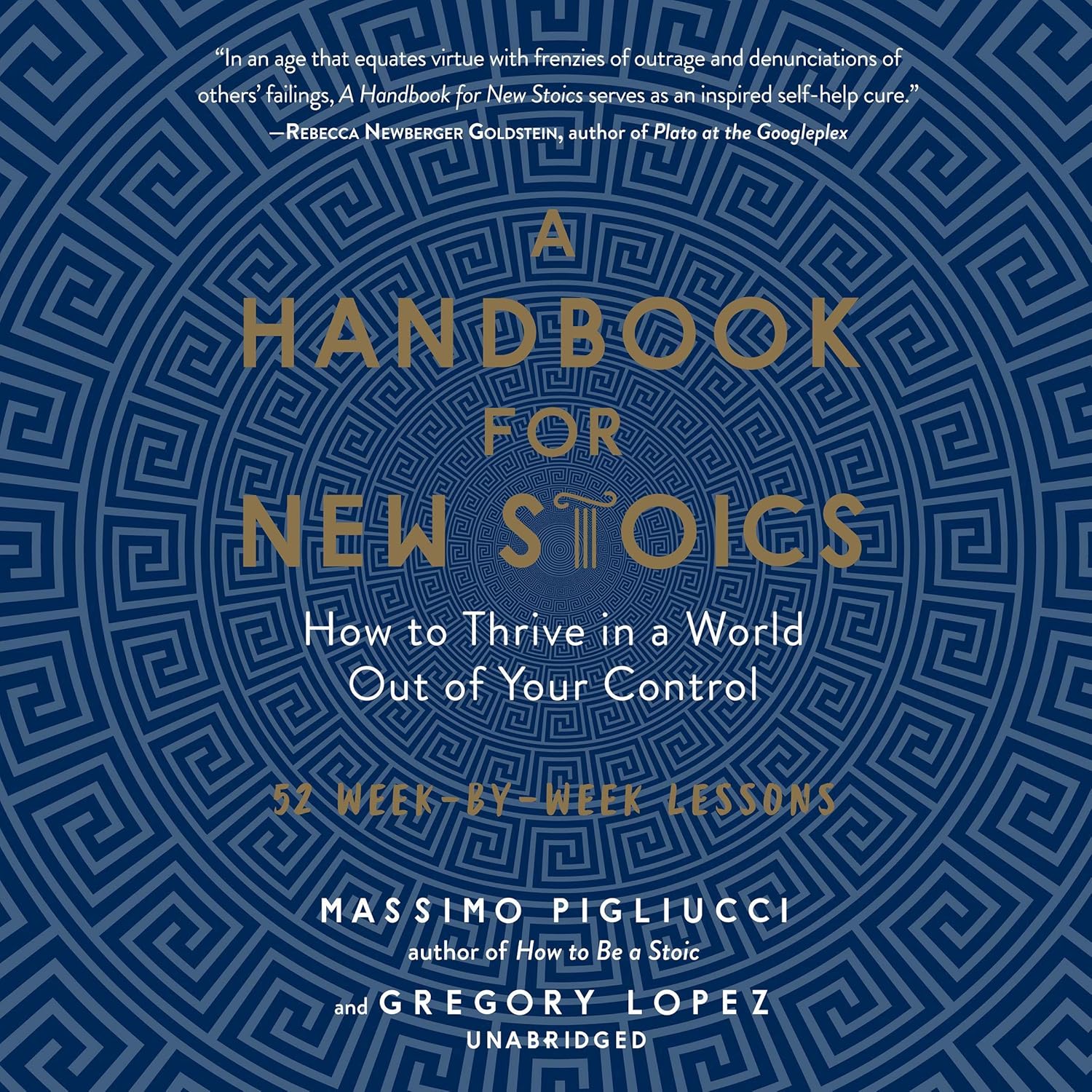
In A Handbook for New Stoics, renowned philosopher Massimo Pigliucci and practitioner Gregory Lopez guide listeners through 52 weekly lessons, each based on a common obstacle. Stressing out about a meeting at work? Try listing the things you can control and those you can’t. Epictetus writes: “In our power are thought, impulse, will to get, and will to avoid” – in other words, our own attitudes. Discover what you can control and quickly achieve peace of mind.
Featuring quotes from philosophers, analysis by the authors, and journaling activities, these lessons enable listeners to reframe their perceptions and be happier.
Review
I try to read one or two philosophy books a year. I read two here at the end of the year with this one and Book of Joy. I preferred Book of Joy, but would also considered this one a worthwhile effort.
And I say that with a caveat. I could have gotten more out of this book if I consumed it as it was intended. This intro to stoicism is meant to be an exercise book. It is not a binge read, but a guide to performing some self work. Only, I binge read it. I had my reasons. Well, reason. I only had it for two or so weeks, not 52. And as the author noted at one point early in the book, stoicism is one part theory and one part doing.
It is broken into three sections, the three disciplines: logic, physics and ethics with desire, action and ascent.
Stoicism is probably most succinctly summed up in the serenity prayer. You know the one.
“God grant me the serenity to accept the things I cannot change, the courage to change the things I can, and the wisdom to know the difference.”
There is more depth than that, but the prayer is not a bad tl;dr summary.
It is another book, like Book of Joy, that is heavy on seeking perspective, not only about others but about yourself.
Some notes I jotted down while reading:
- Talk to yourself in the second person (advise yourself). Know empathy vs sympathy, and which you should feel for yourself. It is a reminder to not let minor inconveniences ruin a day. Maintain a sphere of perspective that exists beyond just yourself.
- Remember the 32nd rule of Stoics Club (we have a few) is you don’t go around telling people you are a stoic. Show, not tell. Hopefully, this book is a reminder to practice things you already inherently know.
- Criticism can come from a place of caring.
- We have no control over the past, and little over the future.
All in all, this is a decent broad view of stoicism. In fact, I would recommend reading this before diving into Marcus Aurelius’ Meditations, which is probably the most often read work of stoicism there is.
3 of 5 stars. Likely better if I did the exercises.
 I Am Weez