

Amazon Blurb
PULITZER PRIZE FINALIST • A “cleanly written [and] artful . . . page-turner” (San Francisco Chronicle) about a nine-year-old girl’s disappearance and the lasting impact it has on her close-knit community
“Compelling . . . both harrowing and deeply felt.”—New York Daily News
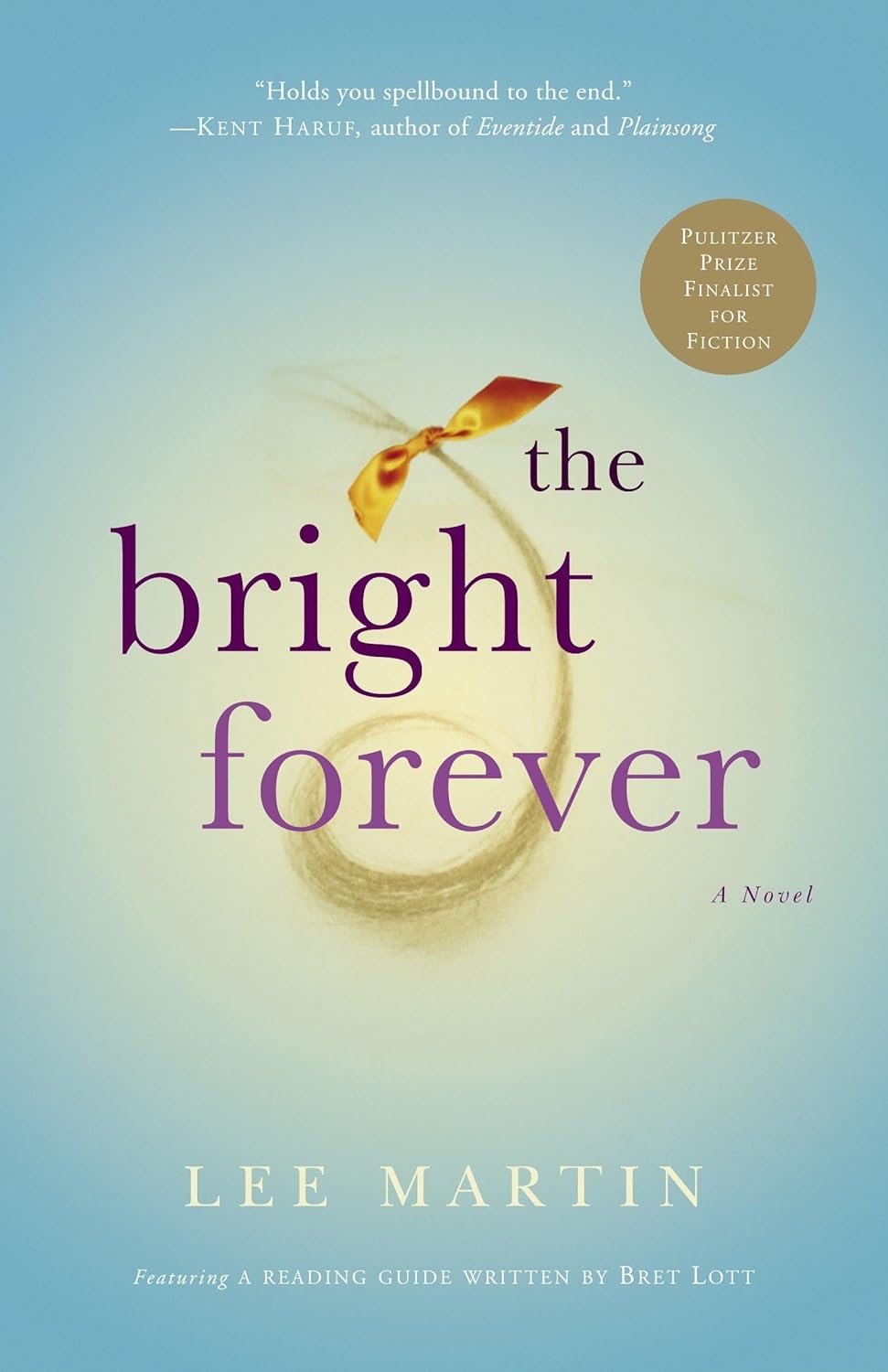
On an evening like any other, nine-year-old Katie Mackey, daughter of the most affluent family in a small town on the plains of Indiana, sets out on her bicycle to return some library books.
This simple act is at the heart of The Bright Forever, a suspenseful, moving novel about the choices people make that change their lives forever. Playing fact, speculation, and contradiction off one another as the details unfold, Lee Martin creates a fast-paced story that’s as gripping as it is richly human. His beautiful, clear-eyed, spartan prose builds to an extremely nuanced portrayal of the complicated give and take among people struggling to maintain their humanity in the shadow of loss.
Memorable for its perceptions and power, The Bright Forever is a captivating and emotional tale about the human need to know even the hardest truths.
Review
I read The Bright Forever in a single day, motivated by a deadline. That same evening, I had the chance to see Lee Martin in person at a book signing in Olney, where he talked not only about this novel but also its sequel, The Evening Shades. Experiencing the story and then hearing from the author himself made for an nice little day.
This was an especially meaningful moment for my wife, who considers Lee Martin her favorite author. He’s originally from her area, and in an interesting connection, her family has even farmed his family’s ground. That kind of local tie adds another layer of closeness when reading his work. It feels like his stories don’t just describe a place, but speak from within it.
The Bright Forever is set in a small fictional town in Indiana, but it draws from real events. It’s loosely based on the Dottie Cavanaugh murder, which happened in Lawrence County, not far from where Martin grew up. While the story involves the disappearance of a young girl, the novel is less about the crime and more about the people surrounding it. The characters, and even the town itself, are at the heart of the story.
Martin uses multiple points of view to tell the story, with time jumps and scattered perspectives slowly revealing what really happened. This shifting narrative adds a layer of mystery, especially because it opens the door to unreliable narrators. As a reader, you’re constantly asking who is being honest and who is hiding something. Henry Dees, in particular, comes across as the most likely unreliable narrator, and that uncertainty keeps the tension strong throughout.
At its core, the book explores regret, loneliness, and the decisions people make because of both. Those themes connect every character, showing how isolation and guilt ripple through a community. The town itself becomes almost a character in the story, shaped by secrets and sorrow.
Reading The Bright Forever was powerful. It stays with you. Seeing Lee Martin talk about the continuation of the story that same evening only deepened my appreciation. This doesn’t just tell a story but reveals what it means to carry weight we can’t always name.
I look forward to getting to The Evening Shade in the future. I try not to jump ahead in my reading list, but there are exceptions. It may be one.
Spoilers Below, Sort Of
One of the most compelling elements of the novel is the space Martin leaves for interpretation. The multiple viewpoints, especially with Henry Dees, create a story that invites the reader to imagine different outcomes or hidden truths. While the book follows the basic shape of the true crime it’s inspired by, I found myself imagining how it might have ended if it had taken another turn.
In the version I built in my head, Mr. Mackey pulls strings to get Raymond released from jail. Then, driven by control, he manipulates his son Gilley into killing Raymond. Gilley does it, desperate to prove something to his father, but he gets caught and ends up in prison. Later, Mrs. Mackey learns that Raymond wasn’t actually the one who killed Katie. The real killer was a worker Mr. Mackey had fired earlier in the story.
The book, in this imagined version, ends with Mrs. Mackey quietly holding this knowledge. She is left debating whether to tell her son, who now sits in prison for killing the wrong man. She also wrestles with whether to confront her husband, who is consumed with guilt over the role he played in their son’s actions.
This alternate ending would have echoed the book’s central theme: the burden of regret. Nearly every character is shaped by what they wish they had done differently. Martin may not have written this ending, but he created a story rich enough that readers like me can’t help but imagine our own.
 I Am Weez