

Blurb
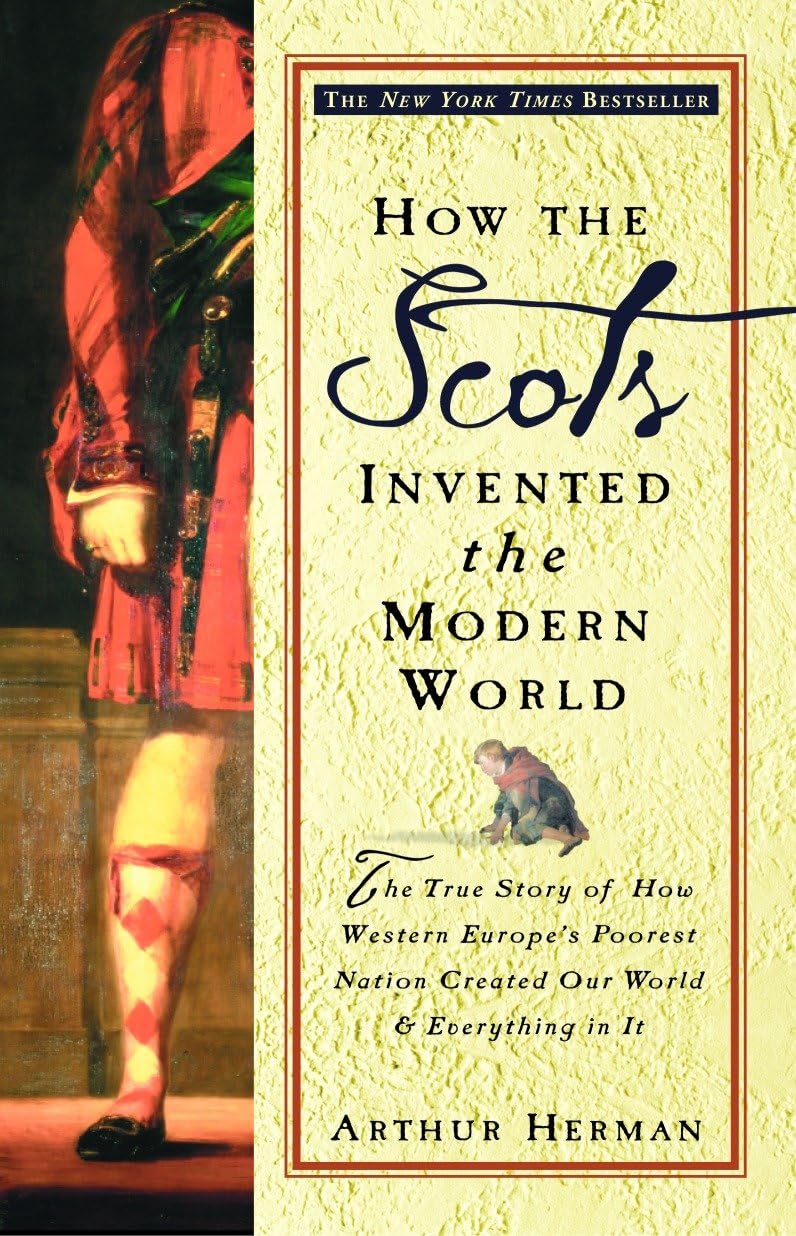
Who formed the first literate society? Who invented our modern ideas of democracy and free market capitalism? The Scots. As historian and author Arthur Herman reveals, in the eighteenth and nineteenth centuries Scotland made crucial contributions to science, philosophy, literature, education, medicine, commerce, and politics—contributions that have formed and nurtured the modern West ever since.
Herman has charted a fascinating journey across the centuries of Scottish history. Here is the untold story of how John Knox and the Church of Scotland laid the foundation for our modern idea of democracy; how the Scottish Enlightenment helped to inspire both the American Revolution and the U.S. Constitution; and how thousands of Scottish immigrants left their homes to create the American frontier, the Australian outback, and the British Empire in India and Hong Kong.
How the Scots Invented the Modern World reveals how Scottish genius for creating the basic ideas and institutions of modern life stamped the lives of a series of remarkable historical figures, from James Watt and Adam Smith to Andrew Carnegie and Arthur Conan Doyle, and how Scottish heroes continue to inspire our contemporary culture, from William “Braveheart” Wallace to James Bond.
And no one who takes this incredible historical trek will ever view the Scots—or the modern West—in the same way again.
Review
With a trip to St. Andrews on the horizon, I figured it was time to brush up on some Scottish history. Arthur Herman’s How the Scots Invented the Modern World seemed like a good place to start. I expected Adam Smith to pop up. Maybe a few monks preserving knowledge during the Dark Ages. What I got instead was a dense but surprisingly wide-reaching lesson on how one relatively small group of people punched well above their weight in shaping modern Western civilization.
This isn’t a book review in the academic sense. It’s more a reflection on what stuck with me—little threads I pulled on while listening to the audiobook (note: probably not the ideal format at 1.5x speed for a work this rich).
The Seeds of Modernity
One of the most striking ideas early on was how democracy first took root not in government, but in the Church. George Buchanan’s writings predated many Enlightenment thinkers and laid philosophical groundwork for equality and self-governance. Scotland even passed an early Schools Act requiring that every child learn to read. That focus on literacy created a ripple effect for centuries.
There’s also a fascinating thread on how Scottish ideas about morality and economics became embedded in American DNA. David Hume and Adam Smith are central here—fathers of modern philosophy and economics, respectively. Smith’s Wealth of Nations wasn’t just a foundational text; it was quoted chapter and verse by Alexander Hamilton. Meanwhile, Thomas Jefferson was taught by a Scottish professor at William & Mary, and the lineage from Scottish Enlightenment thinkers to American Founders like James Madison becomes hard to ignore. Some even suggest Madison’s Federalist Papers bear the fingerprints of Hume.
Aesthetics and Infrastructure
I didn’t expect architecture to be part of this book, but Robert Adam’s story stood out. He studied in Italy and returned with a neoclassical style that influenced early American buildings—including George Washington’s Mount Vernon. Thomas Telford, another name I’d never heard, became an engineering marvel—building suspension bridges, designing canals, and even helping with the Panama Canal near the failed Darien colony.
Speaking of inventions, James Watt didn’t invent the steam engine but refined it into something usable on a large scale. Samuel Fleming invented time zones. Joseph Lister revolutionized medicine with antiseptic practices. Alexander Graham Bell and Andrew Carnegie—both Scots. And Robert Owen, the utopian socialist who founded New Harmony, Indiana? That’s just an hour from my house. Small world.
National Identity and Global Footprint
Sir Walter Scott gave the Highlander his mythic status back with Waverley, arguably the first real historical fiction novel. And while Herman’s narrative champions Scotland’s intellect and innovation, it doesn’t shy away from the colonial aspects—Scots played significant roles in the expansion of the British Empire, from Canada and Australia to Hong Kong and Africa.
There’s also a uniquely Scottish streak of self-determination that runs through many of the figures profiled. The book even closes with Self Help by Samuel Smiles—arguably the original self-help book and the origin of the phrase “God helps those who help themselves.”
Final Thoughts
How the Scots Invented the Modern World doesn’t just tell you how important Scots were—it shows you by stacking contribution after contribution in politics, philosophy, engineering, medicine, and literature. At times, it can feel like overreach, but more often than not, Herman makes a compelling case.
If nothing else, I’m going into my first trip to Scotland with a deeper appreciation for what that little country gave the world. And maybe with a few barstool facts to drop in St. Andrews.
4 of 5 stars.
 I Am Weez