

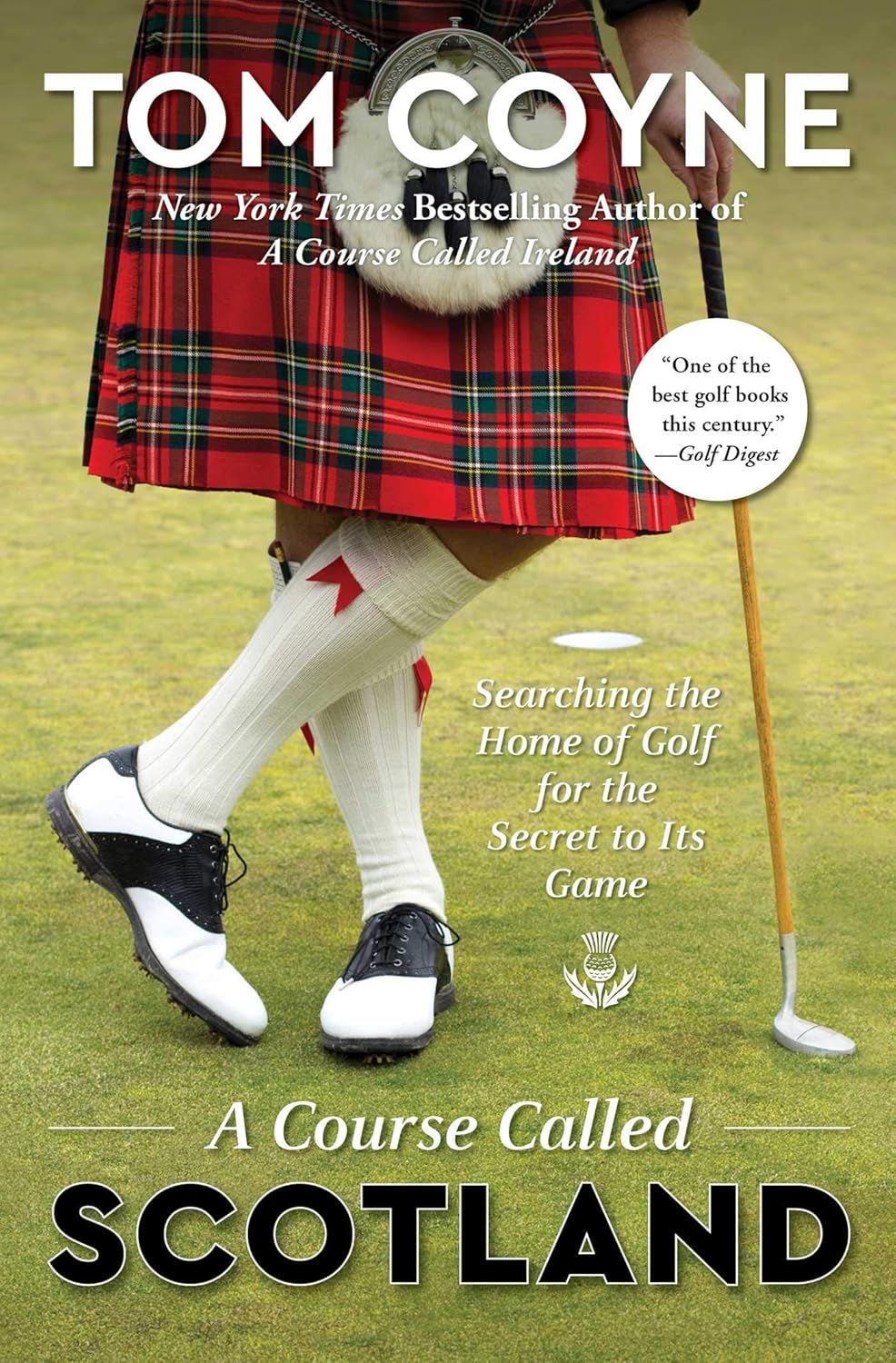
My wife Sarah likes to browse bookstores. I usually go along, even though I already own more books than I’ll ever read. On one of those trips, while waiting for her to finish shopping, I stumbled across A Course Called Scotland, by Tom Coyne. I knew nothing about it—only that I was heading to Scotland to play golf later that year. That was enough reason to grab it. I read about a third before my trip and finished it after. It ended up being a perfect companion before and after the journey.
Coyne opens with the story of St. Rule and how the bones of St. Andrew gave the town its name, capped by its motto: Dum spiro spero—“While I breathe, I hope.” Early on, he writes, “I’m not sure I actually believe any of that, but I do breathe, and I do hope. And maybe Hope will be enough, or maybe it will be too much. When does Hope become the dream that becomes a mistake?” That line set the tone for a book that was far more than a travelogue or a golf diary. It’s a reflection on faith, purpose, and the strange human compulsion to seek meaning through a game that often resists logic.
This isn’t just a hole-by-hole recap of a bucket-list golf trip—thankfully. Coyne blends travel writing with memoir and philosophy, creating something closer in spirit to Zen and the Art of Motorcycle Maintenance than a golfer’s guidebook. His reflections hit deep, especially when he writes, “Golf inherently leads to philosophy by nature. For example, in this book: I’d read somewhere that the key to grappling with fear, feeling real peace and security, was knowing who you were. I believed it, because on a golf course in a competition, I too often guessed at the player I was.” That’s the kind of vulnerability that elevates this book above typical sports writing.
There are moments of practical wisdom too, like his reminder that “Better scores are not necessarily about better shots, but better misses.” And the way he describes golf’s place in the culture of Scotland and Ireland is spot-on: “Nowhere in the States will you find the magical intertwining of golf and town that you witness on the links of Scotland and Ireland, where places like St. Andrews, Dornoch, Lahinch, and Newcastle, golf holes flow into the heart of bustling old villages, clubhouses reide net to pubs and B&Bs, and the course is public green space for the town’s denizens, more of a people’s park than a golf reserve.” Having now walked some of those same links myself, that line resonates in a way it couldn’t have before my own trip.
Coyne doesn’t shy away from personal struggle either. He doesn’t drink, and though he only hints at the reason until late in the book, his eventual revelation about a near-death, alcohol-related hospital stay adds a layer of gravity. I do drink—so our experiences differed—but his reflections on addiction and recovery brought a quiet honesty to the narrative that deepened my respect for him as a storyteller.
Near the end, Coyne touches on the strange comfort of anonymity: being in a clubhouse, seeking the approval of strangers. That one hit close to home. I often feel more at ease with people who don’t know me—a stranger is an opportunity to reinvent myself.
And then there’s the “traveler’s revival”: “I can’t possibly go another foot, but show me something I have not seen before and I am two steps ahead of you.” That could be my own travel motto. I don’t vacation—I travel. I don’t rest—I go. Coyne captures that restless spirit perfectly.
I expected A Course Called Scotland to be a niche book for golfers planning their own pilgrimage to the Old Course. It turned out to be something deeper: part travelogue, part confession, part love letter to a game that mirrors life more than we admit. I’m not sure a non-golfer would connect with it the same way, but for those of us who have chased a ball across the windblown dunes and wondered why we care so much, Coyne’s journey feels familiar.
My copy is already in someone else’s hands—one of the guys from my Scotland trip. I suspect it’ll make the rounds among us, just like the stories we still tell from the fairways over there.
⭐️⭐️⭐️⭐️ (4/5)
 I Am Weez