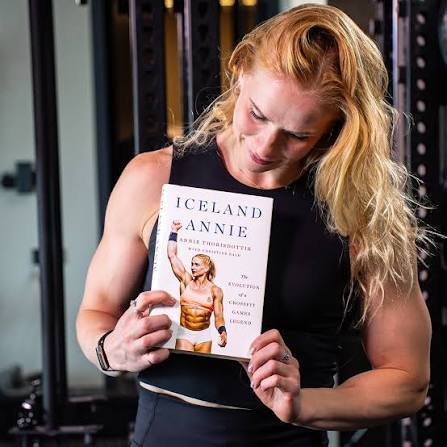
After spending most of the last six months in the Dungeon Crawler Carl universe, an autobiography seemed like an appropriate change of scenery. Fewer exploding monsters. More barbells. Although, given what Annie Thorisdottir has put herself through, the physical demands were still fairly ridiculous.
I came into this book with some history. I started CrossFit in 2011, very out of shape and knowing I needed to change something. I joined what was then T3, Luke and Bridget Ahlfield’s gym, trading some of my equipment for access. That arrangement grew into years of training, local competitions, and coaching classes, surviving three gym owners and multiple locations. Work eventually pushed more of my training toward home, and my competitive interests shifted mostly to powerlifting. When we bought our current house in 2023, we built out the garage gym that became Asgard Athletica. CrossFit is a substantial part of how I got here.
Annie was part of that experience, too. An official CrossFit HQ poster of her, mailed out to affiliate gyms, somehow even made its way onto the wall of my old basement gym. So I was already familiar with the athlete. Iceland Annie gave me a much better understanding of the person whose picture hung above the equipment.
Written with Christine Bald, the book follows Annie from childhood through her third-place finish at the 2021 CrossFit Games after the birth of her first child. I knew about her gymnastics background and her medical-school ambitions. I knew the broad outline of the championships, setbacks, and comebacks. I did not know about the mock Navy SEAL training experience in Iceland, complete with overnight beach workouts, instructors, and an eight-kilometer run. There was plenty here to discover even after years of following her career.
Early on, I wondered whether the book was trying a little too hard to establish its life lessons. Discussions of her parents quickly introduced philosophies about accepting challenges and learning through failure, and some of that felt shoehorned in before I had settled into the story. As the book progressed, though, those ideas gained substance through the experiences she described. The mindset and philosophy ultimately became some of my favorite parts.
One observation concerns Iceland itself. Annie describes a culture where the country’s small size makes achievement feel accessible. You have seen someone succeed, perhaps someone you know, and think, “If she can do it, so can I.” My own version, which I try to remember when I am nervous about something unfamiliar, is considerably less elegant: “Dumber people than me have figured this out.” I recognized the usefulness immediately.
I also enjoyed Carl Paoli’s explanation of being a generalist. Specialization helps you perform tasks you have practiced; a broad background gives you experiences to draw from when solving problems you have never encountered. That gives some meaning to all the different activities Annie pursued before CrossFit. Likewise, Mike Burgener talking about his baby owls produces a wonderfully simple line: “The bird who dares to fall dares to fly.” These conversations show how other people helped her understand and develop her abilities.
The passage that stuck with me most begins with the idea that you either pay in advance through training or receive the bill afterward through cramps and soreness. She broadens that into the cost of pushing boundaries: “Anything is possible, but everything has a price.” Then her dad tells her how proud he is of the life she is living and offers this: “I know it’s not easy, but trust me, it’s less painful than the alternative.” That last part gives the whole conversation its weight. There is a cost to pursuing what matters to you, and there is a cost to never pursuing it.
Her discussion of equality in Iceland also connected with my own experience. When I visited in 2019, our tour guide was visibly proud of the country’s culture around women’s equality. Hearing Annie describe being caught off guard by different expectations elsewhere helped explain something about the assumptions she carried into the world. It was another piece of her background that made her outlook easier to understand.
The competition chapters were fun enough to make me want to revisit footage on YouTube, particularly her first Games win in 2011, the same year I started CrossFit. I also enjoyed hearing about her experiences with Katrin Davidsdottir, whose Dottir I read a few years ago and really liked. But the book reached me emotionally, too. Listening to Annie describe her grandmother passing away while she was competing brought a few tears. Those are the parts of an athlete’s experience that a leaderboard cannot show you.
That limitation becomes explicit after the 2017 Games, when Annie considers whether finishing third might have been her best performance yet—the closest she had come to her potential, despite having placed higher before. The response from the person helping her with the mental side of competition is excellent: “Since when is winning the barometer of getting better?” Coming from a story about someone who has already won twice, that question carries some authority.
Ending with another third-place finish in 2021 brings that idea home. After everything involved in becoming a mother and returning to competition, she lists the achievements represented by that finish, then arrives at: “Best of all. I am me.” Her closing reflection about giving everything to the sport and somehow receiving even more in return resonated with me. I went into CrossFit looking to get in shape. It gave me relationships, experiences, and a lasting place for training and coaching in my life.
I own both the audiobook and the hardback. The photographs in the hardback were fun to flip through, but hearing Annie narrate her own story was the way to experience this one.
Among the CrossFit books I have read, I would put Iceland Annie alongside Katrin’s Dottir, and well above Mat Fraser’s book. I have not read Rich Froning’s yet, and my wife’s review has not made me eager to move it up the list. Tia-Clair Toomey’s The Heart Is the Strongest Muscle remains on my reading list.
Reading this book and watching a James Clear podcast this week have me contemplating signing up for the SPF Worlds powerlifting competition in Florida next month. Registration closes October 18, so I have to make that decision soon. I have spent a good portion of this review talking about Annie’s willingness to attempt difficult things. Now I am sitting here looking at an entry deadline of my own. Apparently, some of it rubbed off. I am feeling inspired to take on some shit.
This is a must-read for CrossFit fans and a very good read for people who have never set foot in a box. Like Dottir, it offers a compelling account of why she became successful: how she thinks, learns, handles disappointment, and finds reasons to keep going. Nine stars, from someone who once had her poster on the wall and now appreciates considerably more of the story behind it.