
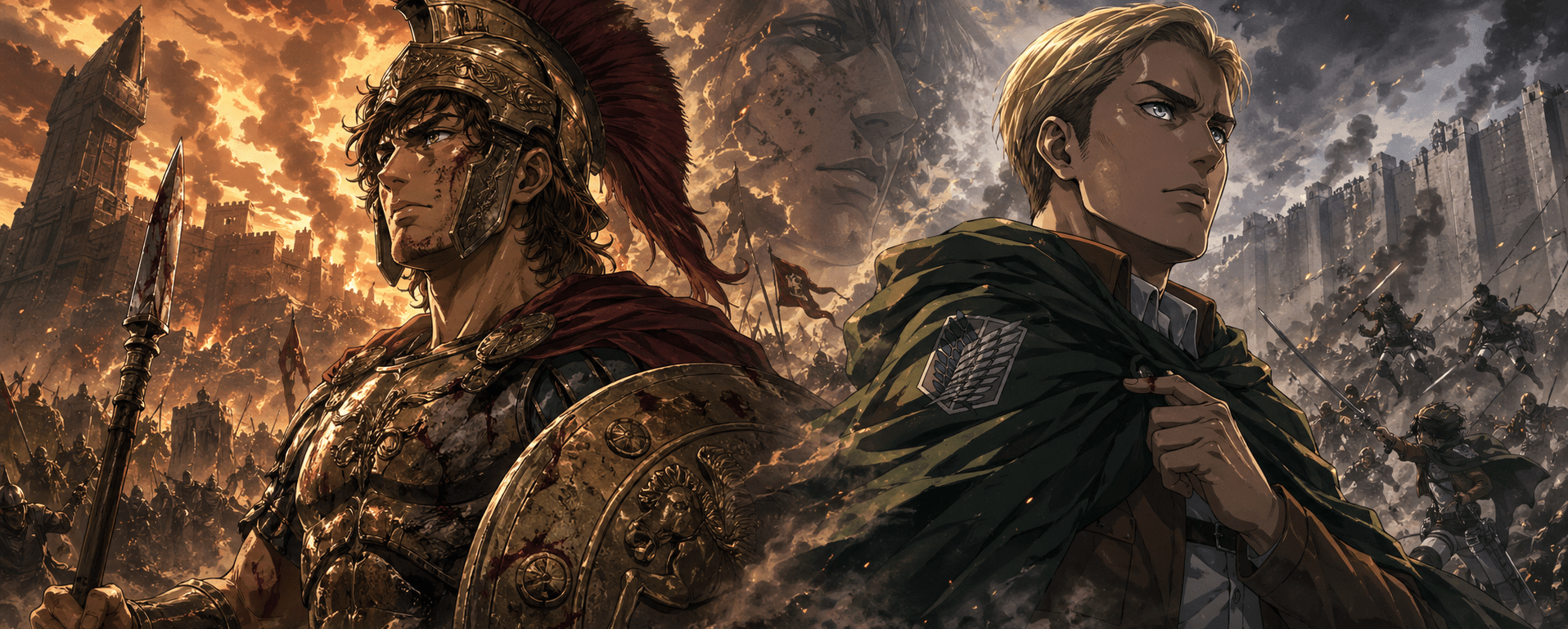
As I work my way through season three of Attack on Titan, I find myself thinking of The Iliad, and one of my favorite literary characters of all time, Hector.
Spoilers for Attack on Titan through Erwin’s charge. Spoilers for The Iliad, though that spoiler warning expired sometime around the Bronze Age.
There is a certain kind of hero who does not survive the story because survival was never the point.
Commander Erwin Smith from Attack on Titan and Hector from The Iliad stand in that same tragic line. They are not heroes because they believe they will win. They are heroes because they understand, with awful clarity, that the world has already narrowed around them. They can see the shape of their own ending. They know the road beneath their feet is paved with bones. And still, they step forward.
That is what makes Erwin feel like a modern Hector.
Hector is not Achilles. He is not invincible, not half-divine, not burning with supernatural glory. He is a man with a city behind him. A wife. A child. A name. A duty. He fights not because he is blind to death, but because he knows death is coming for Troy whether he meets it at the gate or hides from it behind the walls.
In Book VI of The Iliad, Hector tells Andromache, “No one can hurry me down to Hades before my time,” but also admits that when a man’s hour comes, “there is no escape.” That is not swagger. That is a man making peace with the mathematics of fate. Hector knows bravery does not make him immortal. Cowardice would not save him either. So the only question left is what his life will mean before fate closes its fist.
Erwin lives in the same terrible arithmetic.
By the time Erwin gives his “My Soldiers, Rage” speech, he is not selling victory in any clean, heroic sense. He knows the charge against the Beast Titan is almost certain death. He knows he is asking young soldiers to ride into slaughter. And, most painfully, he knows he is asking it while still carrying his own private dream, the basement, the truth, the answer that has haunted him since childhood.
That is what keeps Erwin from becoming a simple marble statue of military virtue. He is not pure. He is not a saint in a cape. He is brilliant, ruthless, inspiring and compromised. He has stacked bodies in service of a goal. The Attack on Titan Wiki describes him as the 13th commander of the Survey Corps, a leader willing to sacrifice his men for humanity’s future.
That sounds noble from a distance. Up close, it is uglier. It has teeth.
But Hector is not clean either. His code of honor helps keep him on the battlefield even when he knows Troy is doomed. He loves his family, but he cannot fully choose them over the expectations of the city. He cannot bear the shame of retreat. He says, in effect, that war belongs to him most of all. To modern ears, some of Hector’s duty sounds glorious and some of it sounds like a prison with bronze hinges.
That is why the comparison works. Erwin and Hector are both trapped inside systems that call sacrifice noble after making sacrifice necessary.
Hector stands before Troy. Erwin stands before the walls. Both men carry civilization on their backs, or at least the civilization they understand. Hector is the shield of a doomed city. Erwin is the blade of a species caged by Titans and lies. Each man has a private self that wants something simpler. Hector wants home. Erwin wants truth. Neither gets to keep that self intact.
The greatness of Erwin’s final speech is that he does not deny death. He weaponizes meaning.
When he tells the soldiers that the dead only have meaning because the living refuse to forget them, he is making the same claim Homer keeps circling for thousands of lines: death is unavoidable, but memory is contested ground. A body can be broken. A name can still march.
That is the true bridge between Erwin and Hector. They both understand that a meaningful death is not about dying beautifully. It is about dying in a way that gives the next person something to stand on.
Hector dies outside the gates of Troy, and his death marks the beginning of the city’s final unraveling. But he also becomes the human center of The Iliad. Achilles may be the storm, but Hector is the hearth. He is the one whose death hurts not because he is the strongest, but because he is the most recognizably human.
Erwin’s death functions similarly. In a story full of monsters, transformations and nightmare physics, Erwin’s final act feels painfully human. He is scared. He is conflicted. He wants to live. He wants the answer. Then he gives that up. Not because death is good. Not because sacrifice is sweet. But because someone has to buy time for the future.
“My soldiers, rage!” works because it is not a motivational poster. It is a funeral drum. It is a man telling the doomed not to go quietly into the machine. Scream. Fight. Push forward. Make the world pay attention to the fact that you were here.
Hector would have understood that.
He would have understood the burden of command. He would have understood the shame of failing the dead. He would have understood the awful bargain where a leader’s courage is measured by how much of himself he is willing to feed to the cause.
And Erwin would have understood Hector standing outside the gates, knowing Achilles is coming.
The tragedy of both men is that they are too clear-eyed to be called fools and too doomed to be called winners. They do not escape fate. They give fate a purpose.
That is why Erwin feels like the modern Hector. Not because their worlds are identical. One belongs to spears, chariots and gods. The other belongs to ODM gear, Titans and political rot. But both men stand at the edge of annihilation and decide that the highest achievement left is to make their deaths useful.
Some heroes win by living.
Erwin and Hector win by becoming the reason others continue.
 I Am Weez