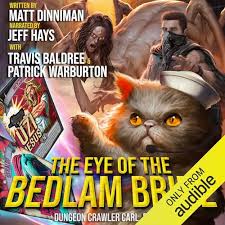
I jumped back into Dungeon Crawler Carl after taking a break for The Odyssey and The Almanack of Naval Ravikant, and somewhere along the way I realized this has become the longest series I have read in years. Probably the longest since I was tearing through Dragonlance books as a teenager. That made the opening recap feel strangely appropriate. By Book 6, this world has gotten big enough that even the author seems to be acknowledging, “Yeah, you might need a refresher.”
And you do. There are factions, gods, corporations, crawlers, NPCs, AI politics and enough recurring characters to occasionally give House of the Dragon a run for its money.
I have always identified more with Carl than Princess Donut, while my wife is mostly here for Donut. But I will admit Dinniman has continued to give Donut more depth, particularly since the Beatrice storyline, and Sassy Donut remains one of the funniest parts of the series. Her takedowns of bullies, including Captain Enormous, had me legitimately laughing out loud. The same goes for little throwaway moments like a crawler note that goes from “I don’t know, they’re kind of cute” to “Nevermind. Fuck spiders.” Or Samantha desperately trying to see Uzi Jesus’ penis. Or Quasar dropping the timeless wisdom, “You can’t unlick a butthole that has already been licked.”
That is the magic trick this series keeps pulling off. It can be completely juvenile one minute and unexpectedly heavy the next.
This book finally digs much deeper into Carl’s childhood and his parents. His mother trying to poison his father. His abandonment. The police briefly suspecting 15-year-old Carl of killing his dad. His father’s constant need for attention. Suddenly, a lot of Carl’s personality comes into sharper focus, particularly his sense of duty and his inability to walk away from people who need him.
Mordecai even calls that out directly, telling Carl that this sense of duty is part of what makes him good. Of course, the dungeon immediately weaponizes that trait by forcing the looming choice between Donut and Katia.
One line in particular landed hard when Carl confronted the ghost of his father:
“I’m not scared of shadows anymore. Not now that I have seen what is really out there.”
That might be my favorite line in the series so far.
The larger story is also changing. I saw someone describe Books 1-4 as “the dungeon happens to Carl,” while Books 5-8 are “Carl happens to the dungeon.” That feels dead on. Carl is no longer just trying to survive the rules. He is learning how to use those rules against the people who created them.
The System AI appears to be doing the same thing.
Its rambling story about coal miners unionizing might be the most obvious example yet that the AI itself wants the system to break. That story eventually produced the rallying cry “Die with your boots on,” a theme that keeps echoing throughout the book: if the system is going to kill you anyway, at least make your final choice your own. Do not die for the corporation. Die for yourself, your family, your friends, your cause.
Even Sir Rendlegore, a character we spend relatively little time with, managed to hit me with her final speech and sacrifice. It was not really sadness over losing the character. It was the defiance. One final “fuck you” to a world determined to control everything about her.
My biggest criticism remains the same one I had with The Butcher’s Masquerade. During the giant finale, my attention started drifting. Once the game mechanics become sufficiently complicated, I assume Carl and company are going to escape through some elaborate loophole I will only half understand anyway. That is pretty much what happened here. The large-scale dungeon mechanics remain the least interesting part of these books for me.
But then Dinniman follows it with an epilogue that reminds me why I keep coming back.
The deeper look into the System AI, the universal politics, the corporations and the machinery behind the crawl is much more interesting to me than another boss battle. I am especially curious what Dinniman is ultimately trying to say about artificial intelligence itself. I am not convinced he is arguing AI is inherently good or evil. So far, it feels more like the AI is another exploited participant in an immoral system, one that is slowly becoming aware of both its captivity and its power.
Maybe that is ultimately the larger theme of Dungeon Crawler Carl: awareness changes everything.
Carl sees the system. The crawlers see the system. The AI sees the system. And systems start getting nervous when the things underneath them realize they do not have to cooperate.
The Eye of the Bedlam Bride can be difficult to follow, occasionally loses me completely in its game mechanics and still somehow manages to bounce from dick jokes to childhood trauma to labor solidarity without snapping its own spine.
Six books in, I think that tonal insanity might be the point.