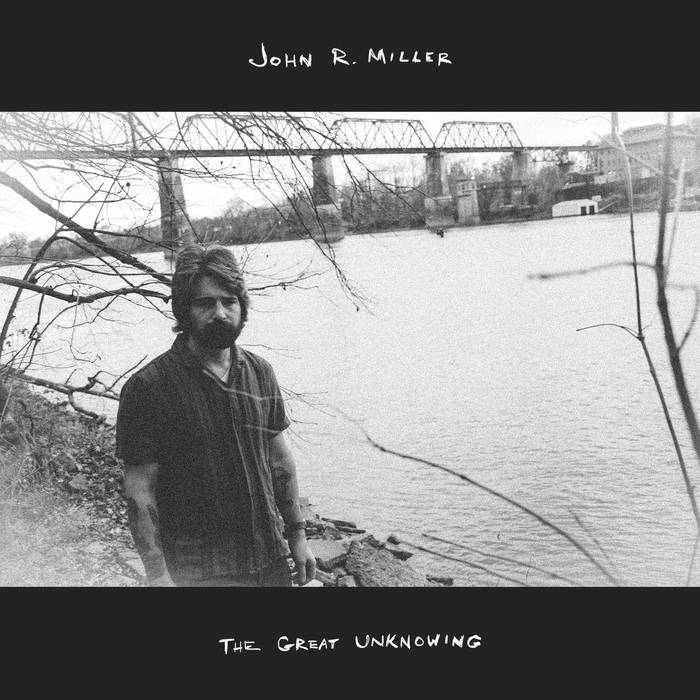
John R. Miller writes the kind of songs that make me think Bob Dylan fans should have a little more faith in the modern generation.
Not because Miller sounds particularly like Dylan. He does not, really. It is more about the way he uses language. The Great Unknowing, his fourth album, is full of rural noir, but more in the turn-of-phrase sense than the narrative one. Think more James McMurtry than Ray Wylie Hubbard. More Mike Cooley than Patterson Hood. Miller does not always need to build elaborate stories around characters and plot. Sometimes he can tell you nearly everything about a person, a town or a bad decision in one crooked little sentence.
That turns out to be the thread connecting a surprisingly varied record.
Miller was raised in West Virginia and has spent years working within the broad alt-country and Americana world, but his musical roots reach into punk, traditional string music and plenty of stranger corners. For The Great Unknowing, he headed to Tulsa to record at Leon Russell’s Church Studio, a place with deep ties to the musical world around J.J. Cale and Shelter Records. That history fits an album that constantly sounds familiar without ever settling into one period or genre for long.
“Far From the Station” is one of the first songs that really shows what Miller does well. It is a pondering song about life, regrets, choices and the inevitable question of what you would change if you could rewind the tape. But Miller does not turn the exercise into melodrama. The song feels more like quietly taking inventory. Regret as observation instead of theater.
“Think I’ll Start Over” heads into similar territory from a completely different direction. It sounds like a convincing John Prine cover, except Miller wrote it. That is a hell of a compliment. Prine’s great trick was always being able to make you laugh at something and then realize thirty seconds later the joke was about loneliness, failure, mortality or some other little human catastrophe. Miller can pull off the same move. “Think I’ll Start Over” is playful, but there is real weight hiding underneath the grin.
Then there is “Looking for a Place to Die,” a title that sounds like it should belong to the bleakest song on the record.
It absolutely does not.
Instead, it is one of the album’s more frolicking tracks, which makes the subject even better. Miller is looking at the financial hierarchy of society, the endless chase for money and status, and the fairly inconvenient fact that everybody at every rung of that ladder eventually ends up in the same place. There is something wonderfully absurd about wrapping mortality and class anxiety in a song that sounds like it might skip down the sidewalk. It is a philosophical shrug instead of a funeral procession.
That tonal contrast shows up repeatedly.
“Daughter of Night” changes the scenery with an accordion-rich arrangement and a dark, wandering old-world feel. It has a slightly dangerous, after-midnight atmosphere, like the soundtrack leaking out of some dim room you probably should not walk into but absolutely will. It is one of the moments where The Great Unknowing proves Miller is not just relying on clever writing. The arrangements have personality too.
“Day Drinking” might be the purest example of Miller’s ability to hide sorrow inside humor. The narrator spends the weekend drinking because, as he puts it, he “just run out of reasons not to.” Funny line. Until you realize the implied reason he used to have for being better is no longer there.
That is where the song turns.
The departure of someone important hangs over the joke, and suddenly all that casual drinking feels less like recreation and more like surrender. One of my favorite lines on the whole album is the wonderfully concise “I told myself…I didn’t listen.” Six words or so, depending on how you count the pause, and you already know exactly what kind of man you are dealing with.
That is Miller at his best. Self-destruction delivered with enough wit to get the laugh without pretending it does not hurt.
“If You Could Only See Me Now” gives the record some straight-up 1970s country bona fides. Pedal steel. Piano. A dark barroom dance floor feel. Not Saturday-night honky-tonk chaos, but the hour when the crowd has thinned, the lights are low and everybody left in the room has a reason they have not gone home yet. It is another reminder of how comfortably Miller can move between styles without sounding like he is trying on costumes.
“Cornbread and Pinto Beans” heads in yet another direction, leaning into folk-talky storytelling. The delivery feels conversational, almost like somebody starts telling you something on the porch and somewhere along the way you realize a song has broken out. That kind of looseness fits Miller. Even when the arrangements change, his greatest strength may be voice in the literary sense. You always know who is doing the observing.
And then, because apparently the album had not wandered enough already, Miller closes with a Dire Straits cover.
“Walk of Life.”
I have to appreciate a country artist making that choice. It is bold, maybe even slightly ridiculous on paper, but I liked the direction they took it. The cover does not feel like somebody dropping a familiar song onto the record because everybody knows the chorus. They pull it into Miller’s own rootsy universe and let it function as one last stylistic left turn.
It is a fitting ending because The Great Unknowing is a record that seems allergic to sitting still.
Country. Folk. Barroom piano. Accordion noir. Existential songs that bounce. Drinking songs that ache. Spoken storytelling. Dire Straits.
Yet the album never feels scattered because Miller’s writing holds it together.
There are plenty of songwriters who can tell you a story. John R. Miller is more interesting to me because he can suggest an entire story with a phrase. He leaves space between the lines and trusts you to fill in the wreckage yourself. That is the rural noir here. Not bodies in the river or crimes in the holler.
A sentence that sounds funny until you realize what it means. A man looking back at the choices that put him miles from where he thought he was headed. A drink poured because the reason not to is gone. A society climbing a ladder that does not lead anywhere permanent. And underneath all of it, the nagging suspicion that nobody really knows what they are doing.
The Great Unknowing, indeed.