
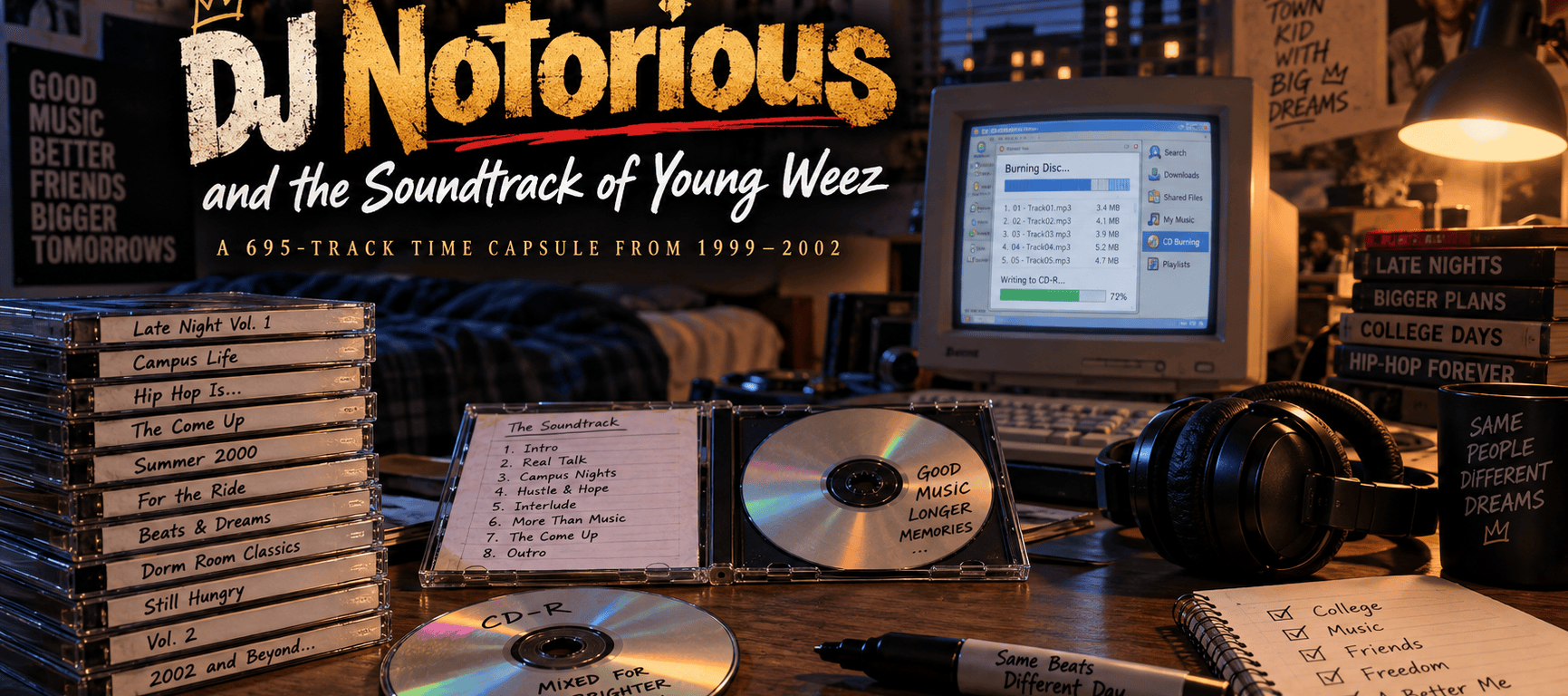
There are easier ways to discover what kind of person you were 25 years ago.
You could dig through old photos. Find a college yearbook. Read an old journal, assuming you were thoughtful enough to keep one.
Or you could spend a month listening to 695 songs that you and your college roommates were downloading from Napster, ripping from CDs, burning onto blank discs and playing loud enough to permanently alter the personality of everyone living within three apartments of you.
That is basically what I have been doing.
One of my college roommates recently found the track listings for a series of hip-hop CDs he burned during our years at Eastern Illinois University and shortly afterward. There were 48 of them, a homemade series we called the DJ Notorious Mixtape Series.
He took pictures of every track listing and sent them to me.
Naturally, I decided this needed to become a project.
I started rebuilding the entire series on Spotify, finding whatever versions I could and putting them back together in one enormous playlist. The final count came to 695 tracks.
And that is still incomplete.
Had Spotify existed as a bottomless archive of every terrible decision we made with Winamp in 2001, the playlist probably would have topped 1,000 songs. A lot of the original CDs contained freestyles, diss tracks, unofficial remixes and random MP3s downloaded from the lawless swamp that was turn-of-the-century file sharing. Plenty of those never made the leap into the streaming era.
The songs that survived, though, form one hell of a time capsule.
Before the algorithm
There was something wonderfully inefficient about discovering music then.
This was Napster. LimeWire. CD burners. MP3 folders with filenames that might or might not contain the actual artist or song title.
We would buy CDs, rip them to a computer, then trade the originals back in at Positively Fourth Street Records in Charleston, receiving progressively worse returns as their trade-in ratio slowly strangled our little amateur music economy.
Every transaction was basically musical depreciation.
Eventually, the computer itself became part of the mythology.
My Sony Vaio was named Mr. Freeze, which I believe was inspired less by Batman and more by the fact that LimeWire malware caused the damn thing to lock up every 20 minutes.
This project also reminded me that I technically once owned a Dr. Dre autograph.
Unfortunately, it was on a cease-and-desist letter related to downloading music from Napster.
Still counts.
The soundtrack changes when you hear it 25 years later
The strange part about rebuilding this playlist was realizing just how clearly it represents a specific moment in hip-hop.
Some observations became obvious almost immediately.
This was peak Jay-Z.
It was early Eminem, before he became an institution and while everything still felt dangerous, funny and slightly unhinged.
The West Coast was trying to figure out what came after Tupac. Snoop Dogg and Xzibit were carrying a lot of that weight while Dr. Dre was busy helping turn Eminem into the biggest rapper on earth.
And behind all of it were producers who seemed to be everywhere.
Dre.
Timbaland.
Jermaine Dupri.
Entire stretches of the playlist feel less like a collection of artists than competing production kingdoms.
Then Clipse appears, and even now you can hear immediately that something different had arrived. That skeletal Neptunes sound still feels alien in the best possible way.
And every few songs, it seems like Nate Dogg materializes to make everything better.
God, I loved Nate Dogg’s voice.
There are technically better singers. There are singers with more range. But few voices ever fit hip-hop better. That tone could make almost anything sound cool.
And then there are the things you forgot
Revisiting old music also means occasionally discovering evidence against yourself.
There is more R. Kelly on these CDs than I remembered.
There is more Diddy than I remembered.
Certainly more than I would like to remember.
And considerably more than I would like entered into the historical record.
But nostalgia does not get to edit the evidence.
That is part of what makes a project like this interesting. You are not rebuilding the playlist you wish you listened to. You are rebuilding what was actually there.
And what was there was very much the hip-hop of 1999 through roughly 2002.
Which means there is plenty of material that has aged beautifully.
And plenty that has aged like milk sitting on the dashboard of a Pontiac Grand Am.
This was an aggressively misogynistic era of mainstream hip-hop. Some of the lyrics that barely registered to me at 20 make me cringe now.
There are songs where I still love the beat, still know every word and also find myself thinking:
Jesus Christ, guys.
Young Weez apparently had very few concerns about lyrical HR compliance.
That probably explains some things.
Same years, completely different worlds
One of the funniest parts of this exercise is comparing my relationship with early-2000s music to Sarah’s.
She is 10 years younger than me.
So when she talks about “2000s music,” we are technically describing the same historical period.
But we are not describing the same universe.
Her 2000s nostalgia is much more likely to involve Ludacris and Nelly.
Mine involves C-Murder, Kurupt and Three 6 Mafia.
Same calendar.
Very different formative experiences.
And, frankly, it is probably better that 14-year-old Sarah was not spending her afternoons absorbing the same material 24-year-old Weez was.
That relationship might have required even more explanation than it already does.
Rate three old songs a day
Once I rebuilt the playlist, it became part of another ongoing project.
Every day, I have a task called “Rate 3 Old Songs.”
The rule is simple: listen to at least three older songs and rate them.
But somewhere along the way I made the rule unnecessarily difficult, because apparently I cannot even listen to music without inventing a scoring system.
Now I only count a song toward the task if it is good enough to add to one of my yearly Best Of playlists.
That changed this DJ Notorious project from passive nostalgia into an actual re-examination.
I am not just listening and saying, “I remember this.”
I am asking:
Is this still good?
And surprisingly often, the answer is yes.
My Best of 2001 playlist has probably doubled in size since I started working through these CDs.
Normally, I add older songs organically. Something pops up in a movie, on shuffle or during a random conversation and earns its way into the archive.
I had never deliberately excavated an entire year of my listening life before.
Turns out there was a lot buried down there.
What survived
The music that has held up best tends to be the same material that never completely left my rotation.
Especially the workout stuff.
Certain songs are basically permanently installed in the Asgard Athletica operating system.
The beats still hit.
The aggression still works.
Some songs may no longer represent who I am at 47, but they can still convince me for four minutes that putting more weight on the bar is an extremely reasonable decision.
That is the odd power of music.
It can outlive the person who originally loved it.
Not literally, of course.
Though in the case of some of our college decision-making, statistically speaking, it feels fortunate that it did.
But the 20-year-old version of me who first heard these songs is long gone.
The music is still here.
And when the right track comes on, pieces of him come back with it.
The apartment.
The burned CDs.
The desktop computer wheezing under the weight of pirated MP3s and probably 19 different viruses.
The endless debates over which rapper was better.
The drive across Charleston. The drives from Charleston to Flora, skipping Discman and all.
The feeling that discovering one new song could change your entire week.
The archaeological dig continues
I am still working my way through all 695 songs.
At three per day, this project could theoretically take a while.
In reality, I rarely stop at three.
Some days the playlist becomes less of a task and more of an archaeological site.
You uncover something you forgot existed.
Then something you completely misremembered.
Then something that still absolutely rules.
Then something that makes you wonder whether everyone involved should have been supervised by an adult.
That may be the best description of early-2000s hip-hop anyway.
So the playlist stays.
All 695 tracks.
The great ones.
The embarrassing ones.
The ones that still live in my regular rotation.
The ones that probably helped shape my sense of humor into something wildly inappropriate for far longer than was socially advisable.
It is not just a playlist anymore.
It is a record of what a group of college kids thought was worth downloading when downloading one song could wreck your computer.
It is 48 burned CDs reconstructed into one gigantic digital fossil.
And somewhere inside those songs is a younger version of me, probably sitting beside Mr. Freeze, waiting 45 minutes for LimeWire to finish downloading something that may or may not actually have been the song listed in the filename.
That kid would probably be amazed that 25 years later I can carry almost every song we ever listened to around in my pocket.
He would also probably ask why I am paying for it.
Some things would take longer to explain than others.
 I Am Weez