

Charles Wesley Godwin has always written like a man with one foot planted firmly in where he came from. West Virginia, family, coal country, mountains, faith, work, memory. Those things have never simply been scenery in his songs. They are the architecture.
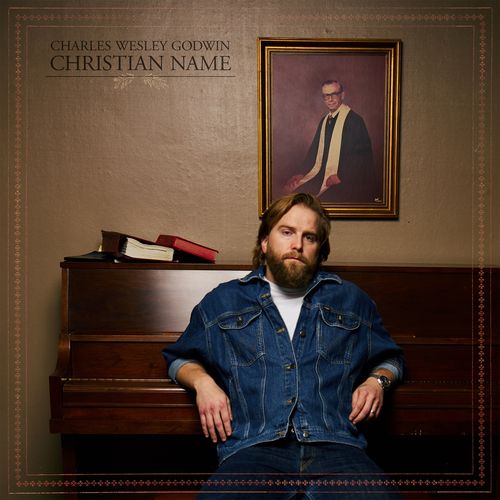
On Christian Name, his fourth studio album, that architecture starts to look a little more like a church.
The title itself comes from Godwin’s late grandfather, Charles Godwin, a Methodist minister for whom he was named. Godwin originally conceived the record around faith and family legacy, but the project took on considerably more weight after he and his wife Samantha lost their son Samuel to stillbirth in 2024. Godwin has since said his wife helped him realize that making the album had become part of how he was grieving. That background explains a lot about why Christian Name can sound hopeful without ever feeling carefree, a distinction that matters.
A lesser album about faith after tragedy might try to tie everything into a neat little bow. Christian Name is certainly more affirming than questioning, something other reviewers have noticed, but there is enough heaviness underneath the optimism that it never feels completely weightless. Godwin himself has talked about intentionally balancing the darkness with lighter perspectives through an unusually collaborative group of co-writers, and you can hear that push toward the light throughout the record.
For me, though, the album works best when I can pull those larger themes back down into my own life.
After the opening Sermon, “Try Again” is the true beginning, and it sounds like classic CWG in the best possible way. It is a song about getting back on the horse after defeat, whether the thing that knocked you down was life, love, failure or something you can’t even properly name yet. That one landed hard, but tinged with optimism.
The perils of constantly trying to improve yourself include being perpetually aware of all the ways you haven’t gotten there yet. “Try Again” speaks directly to that. At some point, improvement stops being a motivational poster and becomes the tedious practice of screwing up, recalibrating and trying the damned thing again. That cycle has been on my mind quite a bit lately, and, if I’m being honest, for much of my life. Of all the songs on Christian Name, this was the one I immediately heard through my own experiences.
“Better That Way,” featuring Luke Combs, was one of the singles I had already heard before the album arrived. I don’t listen to a ton of Combs, but this one is fun. It’s basically a giant musical bowl of Member Berries, to steal the phrase from South Park. Remember this? Remember that? Remember when life was simpler and you had that girl beside you? The song piles up little cultural and personal touchstones, but the trick is that the nostalgia has an emotional center. It isn’t merely remembering old stuff because old stuff was cool. It’s remembering who was standing next to you when those things mattered. Other reviews have similarly noted the song’s emphasis on small pleasures and proud roots, with a bigger, guitar-driven arrangement carrying the nostalgia.
Then comes “Hey There Son,” featuring Wyatt Flores. Dads, you have been warned.
The song moves through a father-and-son relationship with shifting perspectives and the horrifying little trick time plays on parents. One minute, the kid needs you for everything. Then somehow the years collapse, the roles begin changing, and everybody involved is older than they were supposed to get. Godwin started the song around the birth of his first son and later finished it with Lori McKenna, which explains a lot about why the emotional manipulation is so ruthlessly efficient. McKenna knows her way around family songs that leave casualties.
I’m childless, so that particular emotional doorway isn’t mine, but I can still see exactly what the song is doing. And it does it very well.
A little later, “God’s Been Good To Me” provides what may be the album’s simplest lesson:
“God’s been good and I’ve been lucky…”
That basic sentiment is probably more useful than a dozen self-help books. There is a tendency, especially if you’re wired toward improvement, to constantly judge life against what you still want. Stronger. Better. More successful. More accomplished. More disciplined. Whatever the scoreboard happens to be that day. Sometimes you need to remember to turn around and look at the distance already traveled.
Things get heavy. Things go wrong. None of that changes the fact that, viewed from thirty thousand feet, life can still have been pretty damned good. “God’s Been Good To Me” works because it doesn’t require pretending otherwise. Musically, it is one of the album’s more roots-forward moments too, with enough bounce that one review described it as bordering on bluegrass.
“Gospel of the South” takes another route into nostalgia, this time exploring what a place, and especially the family within that place, leaves behind inside you. That is familiar territory for Godwin. His early albums were drenched in West Virginia geography, and Christian Name shifts some of that emphasis from the land itself toward inheritance: what parents, grandparents, churches, towns and traditions plant in us that we continue carrying whether we consciously choose to or not.
That may be the album’s strongest larger theme.
Faith here isn’t presented merely as belief. It is inheritance, memory and identity. The title honors his grandfather, the album imagery was created around the West Virginia church where that grandfather preached late in his career, and Godwin has described his own recent years as a revival of the faith his grandfather modeled. Even for listeners who don’t share his theology, there is something universally recognizable about reaching an age where you start understanding the generations before you differently.
The closer, “Brand New,” is another one that I suspect Godwin intends more spiritually than I personally receive it.
The opening has this cinematic sweep that immediately reminded me of Friday Night Lights. Big sky. Highway. Texas somehow, despite Godwin being about as West Virginia as you can get. Other reviewers heard something similar, describing the song as a cinematic culmination of the record’s pain, faith and redemption.
Lyrically, I hear another version of one of my favorite songwriting themes lately: redeemed by the love of the right woman.
Godwin may be singing about being made new through faith. Fair enough. I hear Sarah. Funny how songs work that way. Your interpretation doesn’t have to cancel the writer’s intent. Sometimes a song is strongest when the artist builds the room and lets you decide who is waiting inside it.
At 6.33, Christian Name isn’t a flawless album for me. “Place I Know” and the title track landed at 5 stars, and much of the middle settles into the solid-but-not-essential 6-star range. I also understand the criticism some reviewers have made that the production occasionally pushes Godwin’s Appalachian earthiness toward a more polished contemporary worship sound. I didn’t find that fatal, but I can hear it.
The peaks, though, are very good and the valley’s are never low with CWG.
More importantly, the record feels coherent. Faith, grief, family, nostalgia, resilience and gratitude keep circling one another until they become different parts of the same subject.
Godwin has spent much of his career writing about where he comes from. Christian Name feels more interested in what he inherited there, what he has lost since leaving it, and what he intends to pass forward. And as somebody who keeps finding more value in songs about building a life instead of merely surviving one, I found plenty here worth keeping.
Album rating: 6.33
7+ star songs:
Try Again
Better That Way (ft. Luke Combs)
Hey There Son (ft. Wyatt Flores)
God’s Been Good To Me
Gospel of the South
Brand New
 I Am Weez